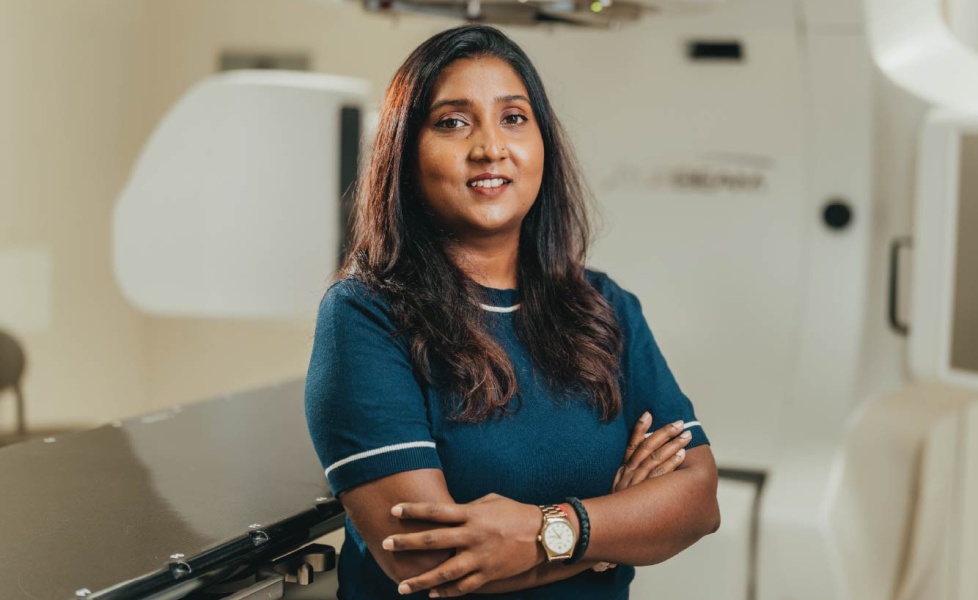
At the C-Care Cancer Centre, Gita Seetohul is the medical physicist behind radiotherapy treatment. She translates complex physics into the calculations and safety checks. Her work rarely makes headlines, yet it underpins the accuracy and safety of the care patients receive.
Gita Seetohul works in a space most patients never see, but one that quietly shapes their treatment. At 34, she is a medical physicist at C-Care Cancer Centre, balancing equipment, data, and patient care. She has spent years helping advanced cancer treatments take root in Mauritius, from setting up radiotherapy departments to fine-tuning the machines that deliver them.”
Radiotherapy is one of the main ways to treat cancer. It uses high-energy radiation to attack tumours while sparing healthy tissue. That is where Gita comes in. Her role is to support that balance, working through the calculations and checks that help direct each beam to the right spot, at the right dose, while limiting exposure.
Gita started in medical science at the University of Mauritius but returned to physics, a subject she always loved, planning to become a teacher. Then in 2017, an opportunity opened up in medical physics, and she decided to pursue it, guided by what she often sums up as “everything happens for a reason”; a mindset she carries alongside her passion for yoga.
“Even a simple CT scan relies on physics. These technologies don’t work without it.”
Her work became even more critical as Mauritius shifted from 2D radiotherapy to advanced, targeted techniques. After completing a Master’s at the University of Rennes 1 and training in France, she returned to help build the radiotherapy unit at the National Cancer Centre. For nearly two years, she focused on calculations, safety checks, and simulations before a single patient was treated.
Today, modern equipment at C-Care Cancer Centre treat with greater precision with advanced radiotherapy techniques, delivering higher doses targeting tumours while still sparing healthy organs. This is to maximise tumour control, andhelp patients experience fewer side effects and have a better quality of life. Although Gita rarely meets patients directly, her input is woven into each stage of treatment, from planning to troubleshooting.
“We work through the machine, but always for the patient.”
As the sole medical physicist in her unit at C-Care, she carries significant responsibility; a job she takes to heart and describes as “a rewarding period of professional growth”.
Her view on cancer care in Mauritius is optimistic. Treatment standards are robust and continuously improving, but screening and early detection still need attention, especially with cases appearing in younger people. “Radiotherapy is a dynamic branch of medicine. Keeping up with new technology is also key”, she says. As technology and care continue to evolve, she looks forward to ways that medical physicists can support patients more directly, combining precision with reassurance to make each treatment as smooth and comforting as possible.
Outside the radiotherapy unit, Gita stays closely engaged with her community. She is an active member of the Rotaract Club of Rivière du Rempart, taking part in local social initiatives, and keeps close ties with her family, values that reflect the same care and attention she brings to her work.